
Through their own lens: Childhood cancer survivors find healing with Photo Voice
The life of a two-year-old should be simple, playful and trusting. For Monica Henderson, her toddler years looked different. In 2001, she was diagnosed with rhabdomyosarcoma, an aggressive soft-tissue tumor. A year of intense chemotherapy and a high-dose radiation treatment to her left face saved her life. By age nine, she was officially cancer-free.
But Henderson still lives with the trauma and costs of surviving. Like 60 to 90% of childhood cancer survivors, she manages health conditions caused by the toxicity of her cancer treatment. She has spent her entire life knowing cancer, without the resources or peers to understand her experience – until now.
Photo Voice, a project presented by the Childhood Cancer Survivorship Clinic at Golisano Children’s Hospital at Penn State Health Milton S. Hershey Medical Center and funded by Four Diamonds, gave Henderson and four other adult survivors of childhood cancer a new way to process their feelings through photos and writing.
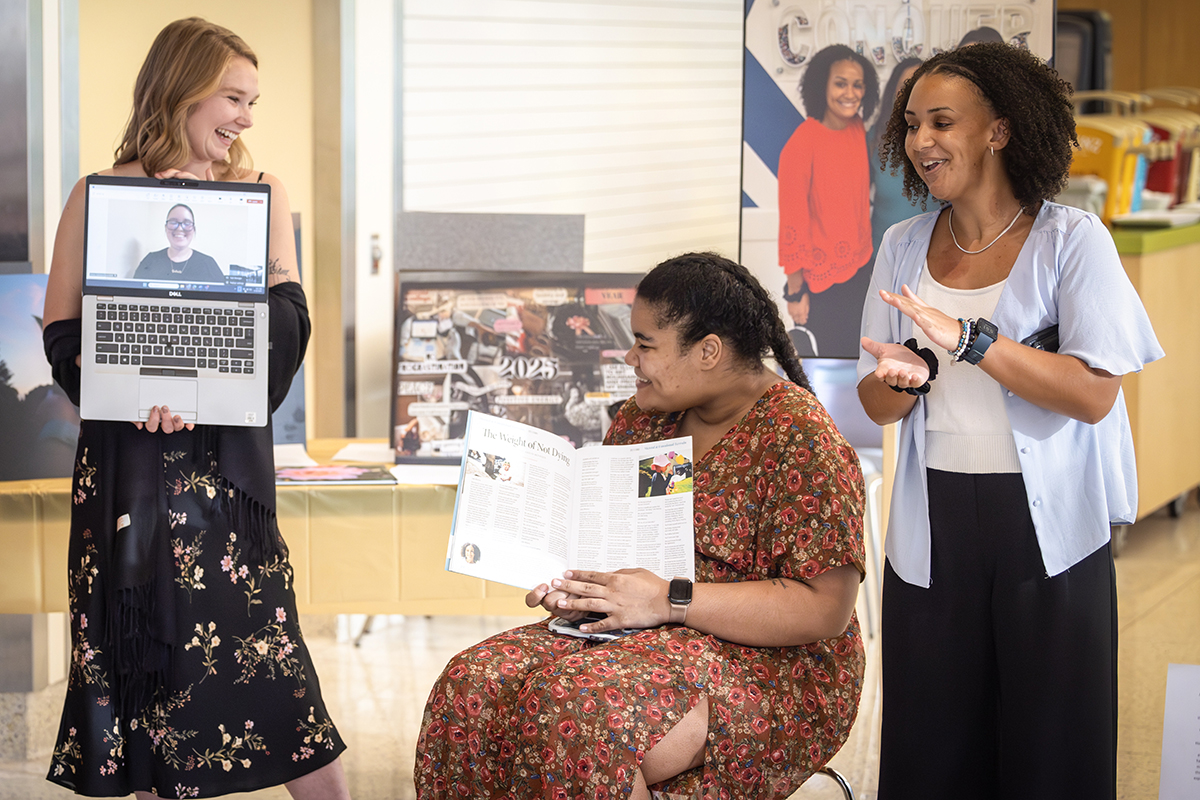
Working with an art therapist and social worker, the group explored challenges with body image, relationships and self-identity – struggles shared by childhood cancer survivors nationwide. Their Photo Voice creations were on display at Penn State Health Golisano Children’s Hospital’s Tree House Café during a Sept. 30 exhibit for friends and family to experience.
View this flickr gallery from the Photo Voice exhibit.

SUPPORT FOR A LIFETIME
The Childhood Cancer Survivorship Clinic focuses on caring for every part of a survivor’s well-being. Dr. Smita Dandekar, the clinic’s director, leads a team of providers who treat all aspects of the post-cancer experience. They include a neuropsychologist, a genetic counselor, a social worker, a nurse coordinator and a nurse practitioner.
“Four out of five children are now cured of their cancer, and these children will live another several decades,” Dandekar says. “We feel a sense of responsibility in pediatric oncology. The treatment doesn’t end at being cancer-free. We must help them thrive and survive in every way.”
The clinic, including the art therapist and social worker, are supported by Four Diamonds, which covers 100% of all medical expenses related to cancer care not covered by insurance for eligible Four Diamonds children. Its mission is to conquer childhood cancer through superior care, comprehensive support and innovative research.
“Having a multidisciplinary program like ours is uncommon,” Dandekar says. “We’re so grateful for Four Diamonds for supporting the services we provide in our program, including the role of our social worker, Meredith Noel.”
ART, WORDS AND SHARED EXPERIENCE
As a social worker, Noel helps survivors find resources they need to thrive, from financial help to mental health screenings to navigating health plans that meet their needs. Inspired by one of her mentors, she started the Photo Voice program with Alexis Steefel, a Four Diamonds-funded, board-certified art therapist.
The program brought together five adult survivors who had been treated for cancer as children. Each week, they discussed different themes around what it meant for them to be a childhood cancer survivor, then took photographs that illustrated their experiences. Many of the participants, now in their 20s, felt particularly isolated before this chance to connect. Henderson didn’t think she fit in anywhere – too old for the pediatric cancer programs that emerged later in her life and too young for the adolescent and young adult (AYA) programs created for those diagnosed between ages 15-39.
“It was really nice to be able to acknowledge both identities I have as an adult survivor of pediatric cancer,” Henderson says. “I deal with unique challenges that people older and younger than me may not face. Being treated as a child and now as a young adult is its own experience.”
When the Photo Voice group met, Henderson was ready to talk – and she found the other participants were ready, too. Steefel and Noel led the first meeting but invited the group to steer the themes for each week. Steefel encouraged participants to take images that conveyed their experiences rather than focusing on the technical aspects of photography or a “pretty” image.
“We gave them photography tips, but the biggest tip was that we didn’t care what the photos looked like,” Noel says. “When we met again, we talked about the photos they took – why they took them and their experiences. Looking at the art and talking about it gave them enough structure to continue the conversation.”
The group took the idea and ran with it. Steefel says the photos and essays they produced revealed raw and honest experiences that surprised even the facilitators.
“When we looked at the first week’s photos and essays, we had to stop ourselves from crying,” Steefel says. “They were just so powerful. We never expected the level of depth that the photos and narratives portrayed.”
HEALING BEYOND TREATMENT
Dandekar says that offering a platform to voice the emotional consequences of pediatric cancer is essential.
“There is a mental health impact of being a childhood cancer survivor. When their peers were out playing sports or making friends, they were in the hospital,” Dandekar says. “When they’re cured, we tell them to go be a kid, but they find that forming relationships can be a struggle because they are more emotionally mature than most of their peers. They’ve undergone a journey that others haven’t.”
Henderson agrees. She recalls that when she shared with friends or strangers that she had survived cancer, the reaction was extreme or insensitive. Some broke down, while others assumed she didn’t remember her treatment. Some found it hard to understand that kids have cancer.
“Receiving that response was just a reminder not to talk about it because people don’t know how to react,” Henderson says. “I never emotionally healed from having cancer because I never fully processed it.”
When the Photo Voice exhibit opened at the Children’s Hospital in September, friends and family were amazed at the impact the experience had on the artists.
“All the parents found me at the gallery and expressed how positively the project had affected their daughters,” Dandekar says. “One mother was in tears, saying the project uplifted her daughter’s spirit. She had finally found her tribe.”
Learn more about the Childhood Cancer Survivorship Program at Penn State Health Golisano Children’s Hospital.
If you're having trouble accessing this content, or would like it in another format, please email Penn State Health Marketing & Communications.