
The Medical Minute: Latest scoliosis treatments help patients stand straighter

A massage therapist was the first person to spot a bump on Emma Price’s back. It seemed like a tender muscle knot that wouldn’t go away. Price’s mother then noticed something else. When her then-13-year-old daughter tried to stand up straight, her shoulders were uneven. Soon, the Lancaster teen discovered what was really going on.
“I saw a video in my history class about scoliosis, and when it started listing the symptoms, I realized that I had a lot of them,” Price, who is now 15, says. “I came home that day and said: ‘Mom, I think I have scoliosis.’”
Scoliosis is a condition in which a child’s spines curves into a C or S shape. It can range from mild and barely noticeable to severe – potentially causing back pain or breathing difficulties.
“A lot of people don’t know that scoliosis gets worse as a child grows,” says Dr. Joseph Petfield, a pediatric orthopedic surgeon at Penn State Health Golisano Children’s Hospital. “The sooner scoliosis is identified and the smaller the spinal curvature is, the more likely we are able to treat it without surgery.”
Here’s how the latest treatments are improving scoliosis care.
What is scoliosis, and who develops it?
Scoliosis can affect the upper and middle spine, known as the thoracic spine, or the lower spine, known as the lumbar spine. It sometimes also involves the thoracolumbar spine where the two meet.
“You can usually see it when you look at someone’s back, especially as they’re bending over, which can make the curve even more noticeable,” says Dr. Brent O’Neill, a pediatric neurosurgeon at Penn State Health.
About 2% of children and teens worldwide have scoliosis, according to the journal BMC Medicine. It affects about twice as many girls as boys and often appears during adolescence.
Scoliosis also affects adults. Adult degenerative scoliosis can develop with age as wear and tear cause spinal misalignment. A study in the European Spine Journal found that about 38% of adults over age 41 had scoliosis. It was most common in women and people over age 60. In adults, scoliosis increases the risk of degenerative disc disease and arthritis. Treatments usually focus on relieving pain and keeping people moving.
Types of scoliosis
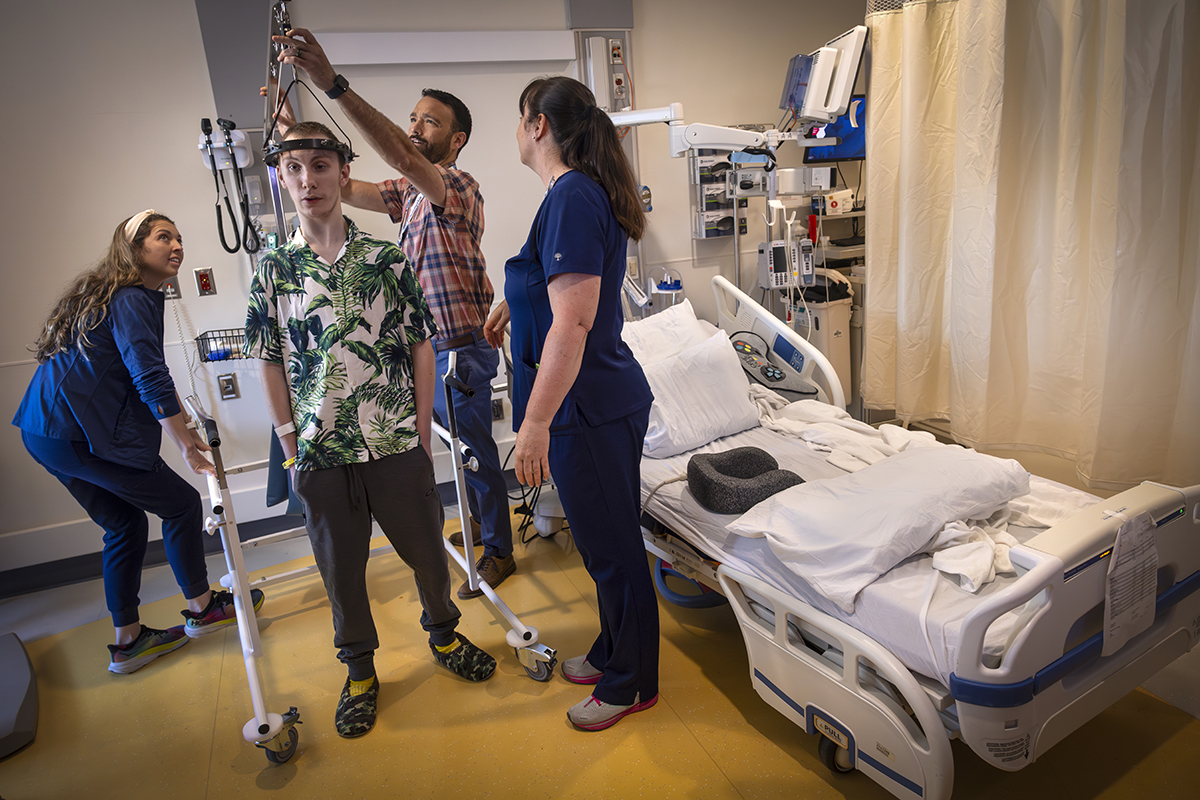
Aiden Shepp gets ready to walk the halls of Penn State Health Golisano Children’s Hospital in halo-gravity traction, a treatment for severe scoliosis that prepares patients for spinal fusion surgery. Registered nurses Janine Hayner, left, and Judith Saldubehere, right, and Dr. Brent O’Neill help him stand.
- Idiopathic scoliosis. The most common type in children and teens, it has no known cause. “These tend to be otherwise healthy kids who just spontaneously develop a spinal curvature,” O’Neill says.
- Congenital scoliosis. This rare form happens when bones in the spine form abnormally. It is often detected at birth.
- Neuromuscular scoliosis: Caused by abnormalities in the muscles or nerves around the spine, it can be seen in conditions such as spina bifida, muscular dystrophy or cerebral palsy.
Managing scoliosis
X-rays help doctors measure the angle of a child’s spinal curvature. In early 2026, Golisano Children’s Hospital at Penn State Health Milton S. Hershey Medical Center will roll out a new EOS Imaging System, which uses a fraction of the radiation of standard X-rays. This reduces radiation exposure for kids with scoliosis, who often need multiple scans per year.
EOS imaging captures both front and side views of the entire spine simultaneously. “We can use the images to make a 3D model of the patient’s spine and closely analyze their spinal deformity and plan how to correct it,” says Petfield, who is also chief of pediatric orthopedics at the Children’s Hospital.
Magnetic resonance imaging can also help doctors check for underlying neurological conditions.
A subtle curvature – about 10 degrees – might not require intervention, O’Neill says. These patients just need to be monitored so they can be treated if the curve gets worse.
“If the curvature is greater than 25 degrees, that’s when we start to think about a brace,” he says. A brace can help direct spinal growth as kids shoot up to adult height. Without it, scoliosis can worsen during rapid growth spurts.
People with mild to moderate curvature may find physical therapy and exercises such as aquatic therapy, yoga and Pilates helpful for strengthening muscles, improving posture and supporting their overall spine health.
Find a Penn State Health pediatric scoliosis expert near you.
Treating severe scoliosis
When a patient’s spinal curvature exceeds 50 degrees, doctors often recommend surgery. “If your curve is greater than that, it tends to progress at about one degree per year even after you’re done growing,” O’Neill says. “It keeps getting worse even during your adult life.”
The most common scoliosis surgery is spinal fusion, in which surgeons use metal rods and screws to connect vertebrae and straighten the spine.
At Penn State Health, pediatric orthopedic spine surgeons work alongside neurosurgeons to treat complex conditions such as scoliosis with tethered cord syndrome – a condition where the spinal cord gets stuck in scar tissue and needs to be released. They also collaborate with rehabilitation physicians and physical therapists to help patients recover as smoothly as possible.
Penn State Health spinal surgeons use the Mazor robotic guidance system. “This advanced technology uses robotics and 3D planning to precisely place the implants we use during spinal surgery,” Petfield says. This tool is especially useful in complex cases, he says.
Some pediatric patients with severe scoliosis can receive halo-gravity traction at the Children’s Hospital, a six-week, in-hospital treatment that uses a metal ring attached to the skull to gradually stretch and straighten the spine before surgery. Petfield says halo-gravity traction improves patients’ lung function and makes surgery safer.
Standing taller, singing stronger
Price was correct – scoliosis was causing the bump on her back, along with crooked shoulders and back pain. She received spinal fusion surgery in November. During her two-day recovery at the Children’s Hospital, physical therapists helped her get moving again. Captain, a golden retriever in the facility dog program, paid her a comforting visit.
Price isn’t allowed to bend, twist or lift objects weighing more than 10 pounds for at least a month after surgery. However, one benefit was obvious before she even left the hospital. She can now take deeper breaths, which helps with her favorite hobby – singing. She started carrying a tune as a toddler and loves to sing in echoey spaces, like parking garages.
“When we come back for our follow-up appointment with Dr. O’Neill, I told Emma we can take a pit stop to the parking garage, and she can get out and sing whatever she wants,” says Daffney Thomas, Price’s mother.
Related content:
- When should I see a doctor about my back pain? Video
- The Medical Minute: Sitting too long? Five remedies for back, neck pain
- Meet spine patient, Dr. John Calaitges: Video
Learn more about scoliosis on the Penn State Health Golisano Children’s Hospital website.
The Medical Minute is a weekly health news feature produced by Penn State Health. Articles feature the expertise of faculty, physicians and staff, and are designed to offer timely, relevant health information of interest to a broad audience.
If you're having trouble accessing this content, or would like it in another format, please email Penn State Health Marketing & Communications.