
LION Mobile Clinic featured by Hospital and Healthsystem Association of Pennsylvania
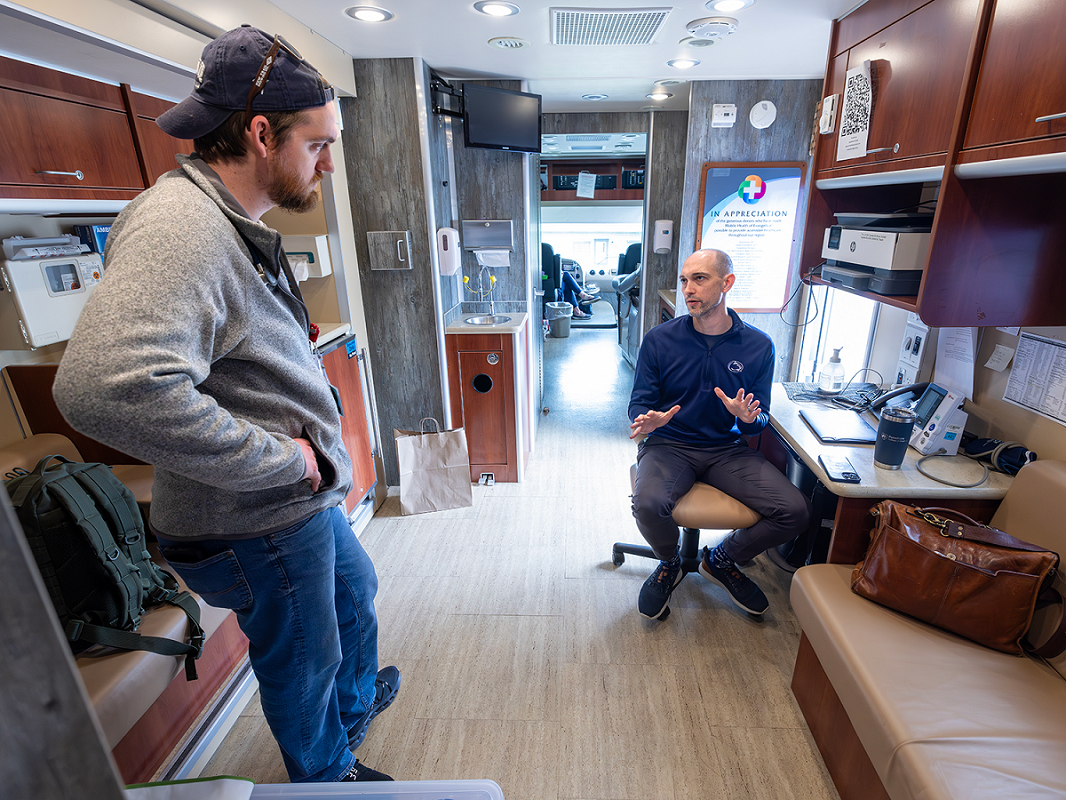
The Hospital and Healthsystem Association of Pennsylvania (HAP) is spotlighting Penn State College of Medicine’s LION Mobile Clinic, an innovative, student-supported initiative that brings health care directly to communities across Pennsylvania.
The feature is part of HAP’s ongoing series highlighting how hospitals across the Commonwealth are advancing care and supporting their communities. In this third edition, HAP focuses on the LION Mobile Clinic’s mission to improve access to care for individuals who face geographic, economic or logistical barriers to traditional health services.
“I help lead the LION Mobile Clinic, which is a student-supported clinic that provides care and resources to underserved populations,” said Michael McShane, MD, assistant director of core clinical medicine and associate professor of medicine at the University Park Regional Campus. “At the end of the day, it’s really about access,” said Michael McShane, MD, assistant director of core clinical medicine and associate professor of medicine at the University Park Regional Campus, who helps lead the clinic. “As a physician, access to health care is a big piece of it.”
Launched in 2022, the LION Mobile Clinic aims to address a significant challenge facing many rural and underserved communities: distance from health care services. In some regions, patients may need to travel 30 miles or more to access care.
“We felt very strongly that there was something we could do to help,” said Mark Stephens, MD, MS, associate dean for medical education at the University Park Regional Campus and professor of family and community medicine. “What we have done is envisioned – and now actualized – a fleet of three pickup trucks and two Airstream trailers that allow us to get farther and farther to where the care is needed, rather than constantly relying on patients to come to us.”
The clinic focuses primarily on prevention and screening, while also providing care at select locations for individuals without health insurance. Beyond clinical services, the LION Mobile Clinic connects patients to resources that support overall health, including food access, housing stability and economic opportunity.
“What we hear from different communities is access to food, access to economic opportunities, access to home improvement – all of those concepts really affect people’s health,” Dr. McShane said. “For many communities that may be geographically isolated, folks may have health insurance, but they may not be able to access health care. So what we try to do is create that opportunity for them to be able to access health care … no matter what stage of life they’re in or whatever their needs might be.
“It’s critical that if we really want to take care of our community, we need to meet them where they’re located.”
The HAP video highlights how the LION Mobile Clinic also helps individuals age in place by offering a safe, reliable source of care within their own communities.
By combining education, service and innovation, the LION Mobile Clinic reflects the shared commitment of Penn State Health and the College of Medicine to improving health outcomes while preparing future physicians to lead with compassion and community-centered care.
Learn more about LION Mobile Clinic
If you're having trouble accessing this content, or would like it in another format, please email Penn State Health Marketing & Communications.