
The Medical Minute: Family on your timeline: Latest trends in family planning, fertility treatments and preservation
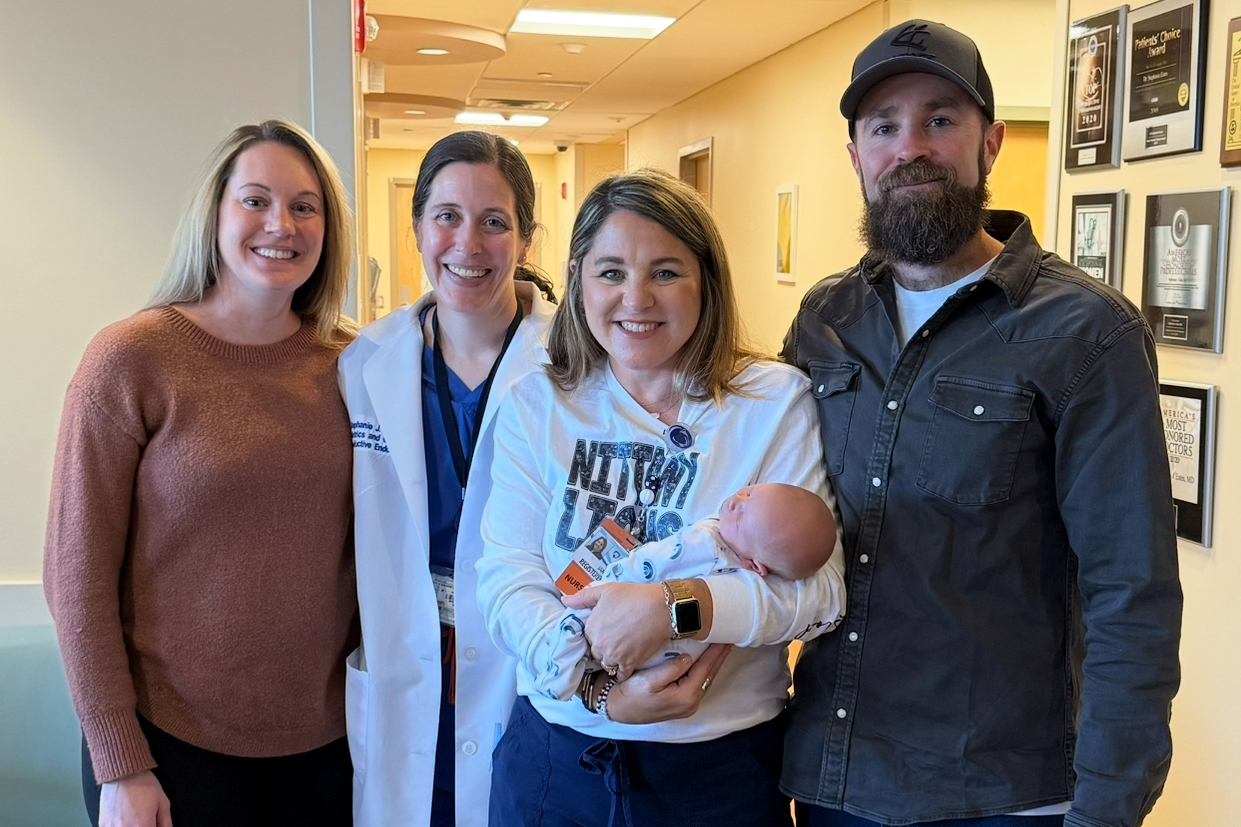
When Jess Hammaker and her husband Justin Baer of Mechanicsburg, Pa., got married in 2020, they knew they wanted children – but not at that moment. The couple, both in their early 30s, had their wedding delayed by the COVID-19 pandemic, and Hammaker was completing her nursing degree. But by 2022, they had been trying to conceive for a year, and the pregnancy tests stubbornly returned a single line month after month. It was time to investigate.
“My husband and I had a lot of lab work done at Penn State Health, and everything came back normal,” Hammaker says. “Dr. Estes gave us two options – either try intrauterine insemination (IUI) or jump straight to in vitro fertilization (IVF).”
The couple chose the recommended three rounds of IUI with no success before moving on to IVF. After two rounds of ovulation stimulation and an egg retrieval, they had six viable embryos. One transfer failed, but the next was successful, and their son Miles was born.
Fertility issues are common
Dr. Stephanie Estes and Dr. Samantha Butts, reproductive endocrinologists at Penn State Health, say that fertility issues are common, though not widely acknowledged. The American Society for Reproductive Medicine estimates that infertility affects 10 to 15% of heterosexual couples.
Reproductive endocrinology addresses disorders of the menstrual cycle and reproductive function in both men and women. Butts says that while her practice primarily sees heterosexual couples struggling with fertility, they also treat other patients, including people interested in becoming single parents using donated sperm or eggs, same-sex couples and people who need help with fertility preservation.
Although IVF is the most intensive fertility treatment, Estes says there are many steps people can take before that to spur ovulation. These include several oral medications and injectable treatments, along with healthy lifestyle choices like a healthy diet, regular exercise and quitting smoking to help create a fertility-

Justin Baer and Jessica Hammaker celebrate their son Miles’ first birthday.
friendly environment.
For some patients, more advanced interventions are needed.
“We try to optimize success and get the balance of risks and benefits with each type of intervention, but we also have to look at the diagnosis,” Estes says. “If someone has low or no sperm, IVF is the only option. If they have normal sperm, tubes and eggs, we generally start with three rounds of ovulation induction with IUI.”
If IUI doesn’t prove successful, as in Hammaker’s case, IVF offers the best chance for a successful pregnancy.
Depending on the patient’s situation, providers will act sooner in some cases.
“If you have polycystic ovarian syndrome (PCOS) and you only ovulate three times a year, I’m not going to ask you to try for a year,” Butts says. “We have to look at your diagnosis and take steps from there.”
New thoughts on contraception
While some couples are desperate to conceive, others want to push pause for a little longer. Estes says more women are requesting longer-lasting contraceptive options, including intrauterine devices and permanent sterilization. Reproductive specialists, she says, now use a simple acronym to determine what birth control option is right for each patient – PATH or Pregnancy Attitudes, Timing and How important is preventing pregnancy.
“You can’t assume that just because someone is a certain age, they do or do not want children. Pregnancy attitude is asking if they might want children, while timing is when you might want that to happen,” Estes says. “The answer to how important it is has changed with the political climate, and we hear more requests for permanent solutions. But our job as providers is to think in the long term. We’re focusing on reversible methods whenever possible.”
IUDs have become quite popular, Estes says, not only because they are low-maintenance but because they allow fertility to resume almost immediately.
“You take the IUD out, and you can start trying right away,” Estes says. “Plus, progesterone IUDs can help with endometriosis symptoms or protect the uterine lining of PCOS patients.”
Preserving fertility
For patients facing medical treatments like chemotherapy, their future ability to have children may be top of mind. Butts says that fertility preservation is a growing demand, especially among young people with cancer diagnoses, recurrent miscarriages or premature ovarian insufficiency (a significant decline in egg reserves before age 40).
Preservation is available for both men and women. Freezing sperm is a fairly quick process, while harvesting eggs and freezing them is more intensive and time-consuming, taking at least two weeks for preparation, ovulation stimulus, testing and freezing. For patients too young to ovulate, Penn State Health is developing an ovarian tissue cryopreservation program. This surgical procedure is also available for patients who need fertility preservation sooner than the time frame needed for egg cryopreservation. Butts expects it to be fully operational by late 2026.
Learn more about fertility services at Penn State Health.
Related Content
- The Medical Minute: Pulling back the curtain on infertility
- The Medical Minute: What a fertility specialist can do for you
- Video: How do I know when it’s time to see an infertility specialist?
The Medical Minute is a weekly health news feature produced by Penn State Health. Articles feature the expertise of faculty, physicians and staff, and are designed to offer timely, relevant health information of interest to a broad audience.
If you're having trouble accessing this content, or would like it in another format, please email Penn State Health Marketing & Communications.