
Penn State Health Feb. 7 town hall highlights economic challenges, information technology, health equity
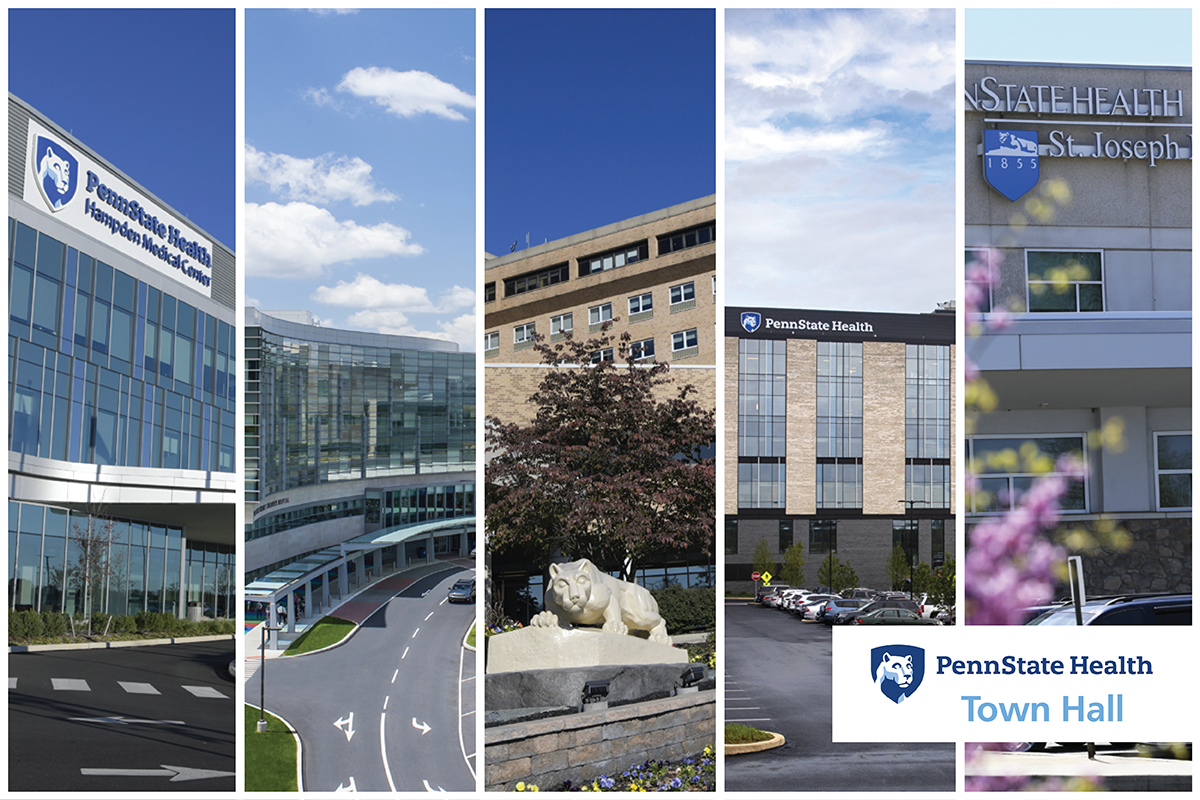
With more than 2,000 Penn State Health employees joining the organization’s Feb. 7 virtual town hall, health system leaders discussed improvements to the information technology infrastructure, efforts to address health equity problems and pervasive economic challenges faced by all health systems in the U.S.
“We’ve got lots of work to do,” said Steve Massini, Penn State Health CEO. “We’re seeing significant financial challenges across the industry, but we have to figure out how to do better here. The long-term interests of our organization, of the College of Medicine and how we support it, all are dependent on us figuring out how to navigate this new world that we live in and figuring out how to create financial results.”
Click on the large play icon in the center of the screen. This will bring up a horizontal menu at the bottom of the screen. To activate closed-captioning, click on “cc” to the right of the volume control.
Read employee questions answered during the Feb. 7 town hall.
Other questions will be answered in the next few weeks and featured in The RITE Stuff and Manager Update.
Economic challenges
Operating expenses were well over budget for the health system between July 1, 2022, and Dec. 31, 2022, Massini said. Planners had expected a shortfall, due mostly to expenses incurred from the openings of Hampden Medical Center in 2021 and Lancaster Medical Center in October 2022, but Massini shared that revenue is down more than anticipated.
The health system’s growth over the past five years has shown results, Massini said. Its overall expansion plan ― shifting from an academic medical center to a health system with new hospitals and practices across central Pennsylvania ― was a response to pressure from encroaching health systems siphoning patients from Hershey Medical Center, he said. Since fiscal year 2017, the number of transfers from hospitals outside of Penn State Health to Hershey Medical Center fell from 6,200 to 4,255. New Penn State Health facilities in the region have largely made up for the loss, referring as many as 1,173 patients in 2022. “It has reversed the trend pretty dramatically,” Massini said.
Maintaining a focus on quality, safety and patient experience is key to righting the ship, Massini said. Penn State Health will also continue to improve patient access and flow, streamline supply chain purchases, evaluate and optimize its leadership structure, hire for open positions that affect patient care and leave others open.
The health system does not plan layoffs, Massini said. “I don’t want to sit here and say anything’s off the table,” he said in response to a question from one of the employees in attendance. “But it’s not really on the table right now. … We are optimistic about the things we are doing.”
Information technology improvements
Among the improved efficiencies, Penn State Health’s Information Services Department installed a physician services line, said Cletis Earle, senior vice president and chief information officer. It allows doctors to call in to the IS Service Desk, select option 3 and bypass long wait times. So far, the line has been averaging 30 calls per day. “Our providers can get back to taking care of our patients,” Earle said.
Other enhancements:
- The Service Desk also added a customer call-back service. Rather than waiting online, employees can leave a phone number so a technician can return their call.
- The health system will use automated systems to deliver faster access to new hires’ email accounts. “Instead of waiting weeks upon weeks, any new hire will have an email account and active directory account established within six hours of when they are inputted into the human resources system,” Earle said.
- Starting in late February, owners will be able to update their own Outlook distribution lists.
- Beginning Wednesday, March 1, Penn State Health will transition all staff drives to Microsoft OneDrive, which will allow greater accessibility to files.
- By Thursday, June 1, Penn State Health will transition away from Zoom to Microsoft Teams for all meetings and webinars.
Addressing health equity concerns
Lynette Chappell-Williams, Penn State Health vice president and chief diversity officer, discussed a plan to advance the health system’s efforts to improve care for all populations.
“One of the things we want to do is make sure every person can attain their highest level of health regardless of what their social or demographic factor is,” she said.
Penn State Health organized teams of employees around six pillars:
- Community engagement
- Health equity research
- Data infrastructure
- Culturally appropriate patient care
- Governance, leadership and workforce diversification and workplace climate
- Organizational accountability
The teams will focus on diversity practices at each hospital and across Penn State Health Medical Group. “They’ll be looking at how we can advance these areas,” Chappell-Williams said.
If you're having trouble accessing this content, or would like it in another format, please email the Penn State College of Medicine web department.