
The Medical Minute: After miscarriage, finding answers and a path forward
Two lines. A plus sign. Pregnant.
For hopeful parents, these first indicators of new life are the happiest moments they can imagine. But for many families, that joy is cut short by an unexpected loss. Nearly a quarter of pregnancies in the United States end in miscarriage before 20 weeks.
Dr. Jaimey Pauli, chief of maternal-fetal medicine at Penn State Health, says miscarriages happen when a pregnancy unexpectedly ends before 20 weeks of gestation. Many women experience one miscarriage and go on to have normal pregnancies without any other treatment, but some experience recurrent pregnancy loss.
For Makenzie Stauch of Hershey, a miscarriage came after a healthy first pregnancy. She welcomed her daughter without complications, but says her second pregnancy felt different from the beginning.
“We had just had our anatomy scan, and we were two days away from 20 weeks,” Stauch says. “I went into pre-term labor, and the cord prolapsed. We lost him.” A cord prolapse occurs when the umbilical cord drops into the vaginal canal, cutting off oxygen and nutrition to the baby.
Find a Penn State Health obstetrician-gynecologist near you.
Understanding the causes of miscarriage
In Stauch’s case, her doctors didn’t know exactly why the pregnancy ended, even after genetic testing – a common outcome. Pauli says miscarriages can happen for many different reasons, including genetic anomalies, a weakened or insufficient cervix, uterine shape irregularities and an autoimmune disease called antiphospholipid antibody syndrome. In some cases, patients have completely normal blood work and no identifiable risk factors, but still miscarry.
“Some patients have no known reason for miscarrying, but often that’s caused by a genetic issue called aneuploidy, which is extra chromosomes or not enough chromosomes,” Pauli says. “Some patients carry a genetic deletion, translocation or difference that, when passed down in combination with their partner, creates a genetic issue that causes the miscarriage. Both parents are completely fine, but together, the child has two copies of something genetically unsustainable.”
While maternal age can play a factor in miscarriage rate, Pauli says miscarriages can happen at any age, and older mothers can have completely healthy pregnancies. She also emphasizes that miscarriage is a traumatic but natural occurrence, and mothers should not blame themselves.
“Every patient I’ve ever met who’s experienced this kind of loss immediately starts thinking about what she did to cause it,” Pauli says. “Was it something she ate or drank? Something she did? This is not your fault. You did not make this happen.”

Treatment options after recurrent pregnancy loss
Since miscarriage has many possible causes, creating a prevention plan can be challenging unless physicians can identify the underlying cause. However, for women with cervical abnormalities, some treatment options may improve their pregnancy outcomes.
Dr. Kristin Riley, chief of minimally invasive gynecologic surgery at Penn State Health, says one option is a cervical cerclage – a procedure that places a suture around the cervix to help it stay closed during pregnancy.
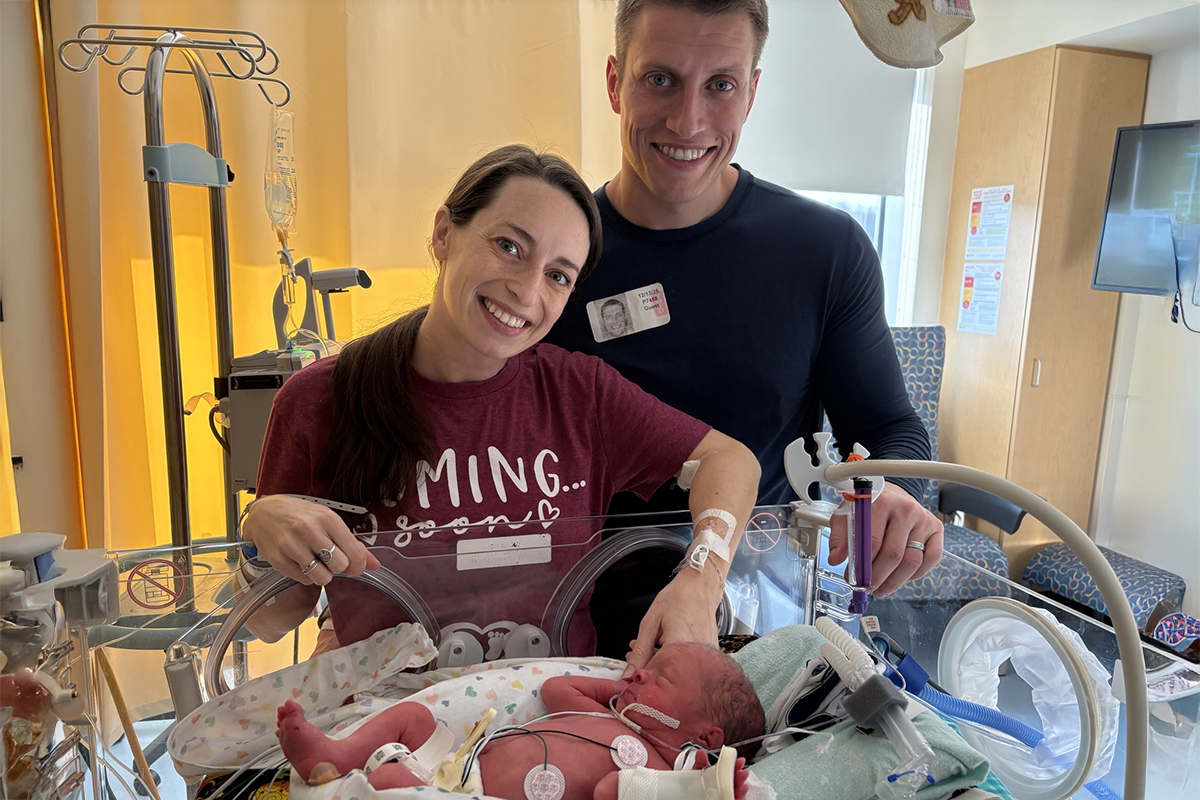
After waiting several months to try again, Stauch became pregnant and received a cervical cerclage. Her son, Andrew, was born at 31 weeks at Penn State Health Golisano Children’s Hospital. After a few weeks in the neonatal intensive care unit, he is now healthy and thriving.
Learn more about Penn State Health’s high-risk pregnancy care.
Traditional cervical cerclage is performed through the vagina, but Riley also offers robotic transabdominal cerclage, a minimally invasive procedure in which the stitch is placed at the top of the cervix. She says the procedure is ideal for patients who have experienced multiple second-trimester losses due to cervical insufficiency or patients who have experienced miscarriage with a vaginal cerclage in place.
“Traditional cerclage is more accessible to place – you put a speculum in, and you can see where to place the suture,” Riley says. “Transabdominal cerclage uses laparoscopic abdominal surgery to place the suture so it’s higher on the cervix.”
Transabdominal cerclage is ideally placed before a patient conceives and can remain for multiple pregnancies. Once it is in place, the mother must deliver via C-section.
Healing after pregnancy loss
While miscarriage is a physical experience, it can also take a heavy emotional toll. Stauch found the support she needed at the Penn State Pregnancy After Loss (PAL) Collaborative Center, a multidisciplinary center offered by Penn State at Milton S. Hershey Medical Center.
Led by Dr. Serena Wu, a maternal and fetal medicine specialist and Dr. Michael Belmonte, a complex family planning specialist, the center brings together

After a brief stay in the neonatal intensive care unit, Andrew joined his family at home. Today, he’s happy and healthy. Photo courtesy of the Stauch family.
experts in maternal-fetal medicine, behavioral health, complex family planning, reproductive endocrinology, internal medicine and social work.
Wu says the PAL team supports the complex needs of individuals coping with pregnancy loss and creates a personalized plan for their path forward.
“We’re creating a safe space for women to navigate their ‘rainbow’ pregnancies, offering parental and group support, as well as complementary therapies,” Wu says.
For families facing miscarriage, answers aren’t always easy to find. But with specialized care, emotional support and advances in treatment, many parents can find hope – and a way ahead.
Ask your provider for information about the Penn State Pregnancy After Loss Collaborative Center.
Explore pregnancy and women’s health clinical trials at Penn State College of Medicine.
Related content:
- The Medical Minute: Family on your timeline: Latest trends in family planning, fertility treatments and preservation
- The Medical Minute: What a fertility specialist can do for you
- The Medical Minute: Pulling back the curtain on infertility
The Medical Minute is a weekly health news feature produced by Penn State Health. Articles feature the expertise of faculty, physicians and staff, and are designed to offer timely, relevant health information of interest to a broad audience.
If you're having trouble accessing this content, or would like it in another format, please email Penn State Health Marketing & Communications.