
After 51 years, Penn State Health physician leaves lasting legacy of compassionate care
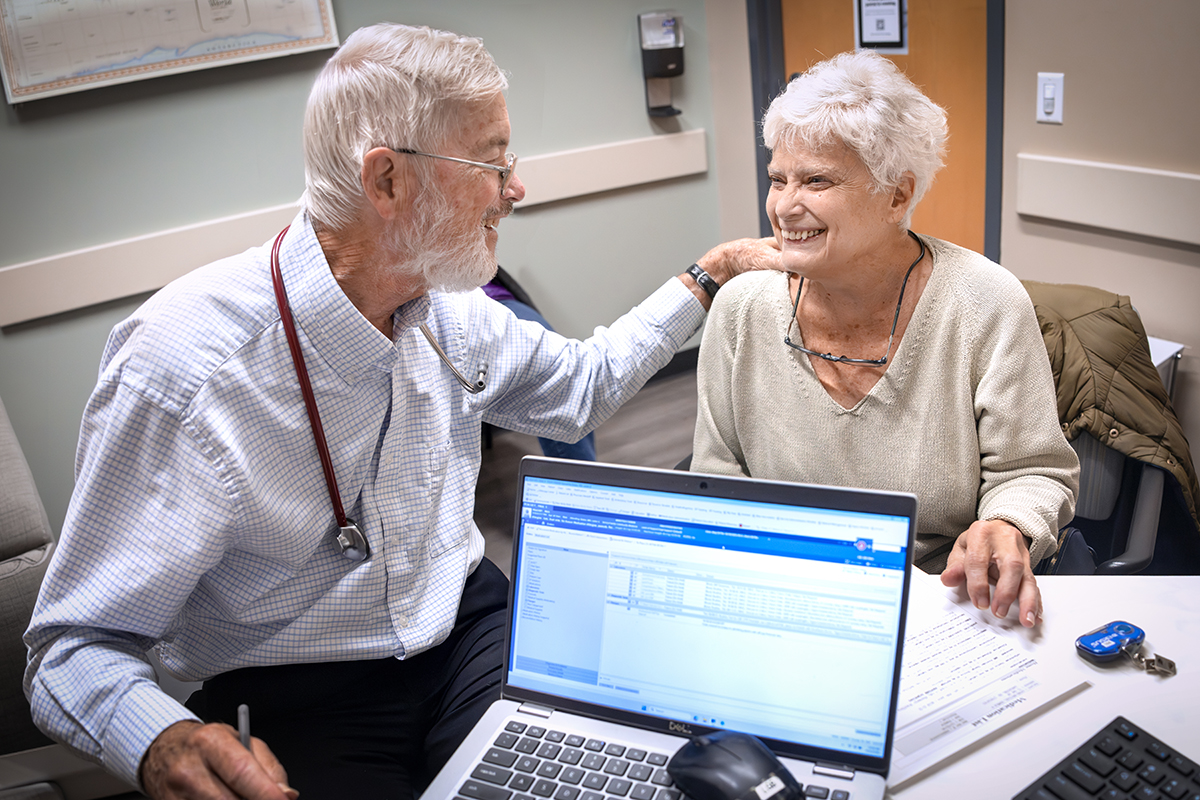
For 51 years, Dr. Larien Bieber made caring for people the heart of his work as a physician. When he retired Oct. 30 from his position as an internal medicine physician at Penn State Health Lime Spring Outpatient Center, he left behind a legacy of compassionate care, dedicated teaching and lasting connections with patients and colleagues.
“He just cares,” says Pamela Lyons-Neville of Lancaster, a long-time patient of Bieber’s. “He looks you in the eye, he listens. I guess you can call it bedside manner, but it’s much more than that. It’s just who he is as a human being.”
For Bieber, 81, medicine has always been about more than diagnosing and treating disease. When he applied to be a member of the Penn State College of Medicine’s inaugural class, he says he was drawn to its psychology and humanities courses, along with its emphasis on caring for the whole person. He was the College of Medicine’s first degree recipient in 1971 and carried that philosophy throughout his 51-year career.
“Patients are real people,” he says. “You have to talk to the person, not the disease.”
Hold cursor over image below to reveal photo gallery controls.

Lyons-Neville says Bieber’s genuine interest in his patients made her feel heard and cared for. “He’s just been the best one could possibly imagine,” she says. “I’m certainly not the only person in this community that feels that way.”
Outside the clinic, Bieber also served as a mentor to medical students and residents at Penn State College of Medicine. “That was very rewarding,” he says.
He was especially passionate about teaching future physicians how to communicate with patients. Along with two colleagues, he developed a communications course to help medical students build those skills.
Bieber also recruited community members to act out different patient scenarios, giving students a chance to practice real-life interactions.
“We had a talkative patient, we had a bad news patient, we had a manipulative patient,” he says, “and the students all had a chance to interact with those patients.”
Bieber’s students have carried these lessons into their own careers as physicians, with some now practicing at Penn State Health.
“His passion for teaching and developing future physicians has helped shape generations of health care professionals,” says Naomi Shreiner, Penn State Health’s vice president of primary care. “His influence will continue to be felt for years to come in the physicians he trained and the patients they serve.”
As he looks ahead to retirement, Bieber isn’t sure what the next chapter will bring, but he plans to continue serving his community through volunteer work. One thing he knows for sure is that it won’t be easy to leave Penn State Health.
“I’m going to miss my friends there,” he says. “I’m going to miss seeing patients.”
If you're having trouble accessing this content, or would like it in another format, please email Penn State Health Marketing & Communications.