
Inside an Epilepsy Monitoring Unit: How advanced monitoring helps find answers
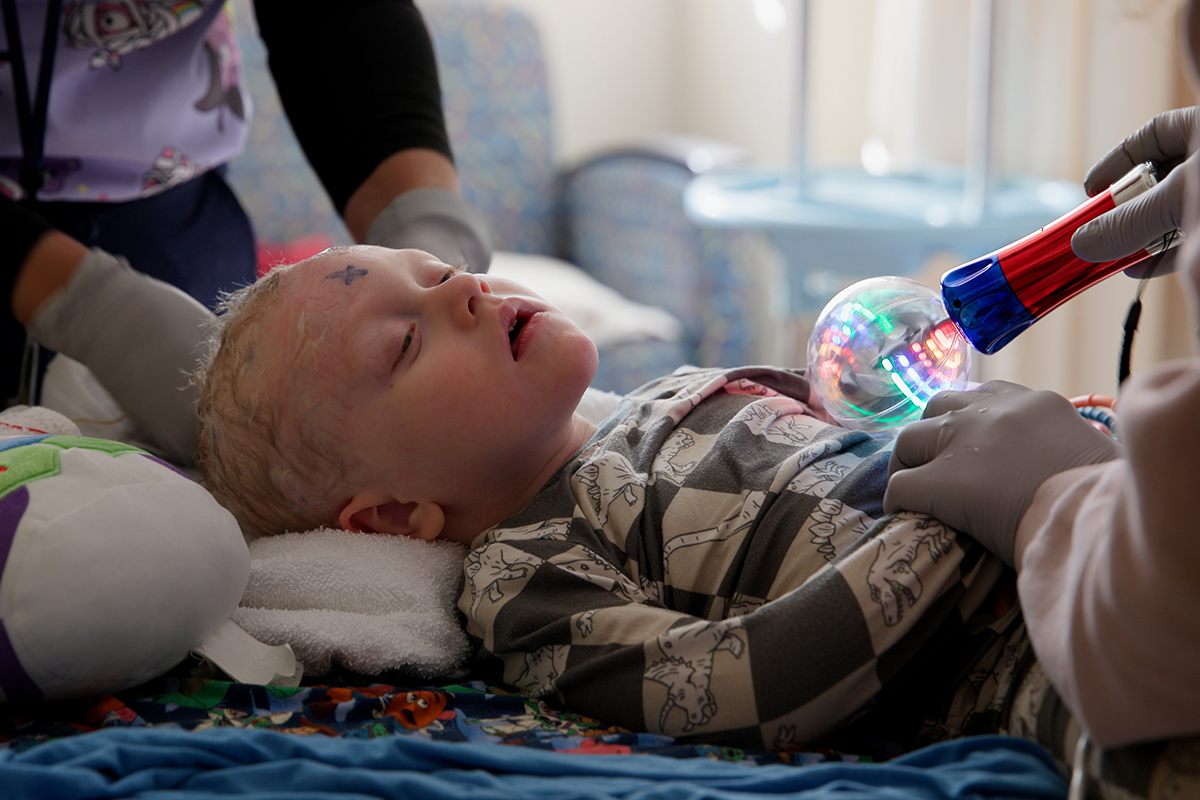
When Anderson White was just 2 years old, he started tumbling to the ground, and not in the normal toddler way.
“He has drop seizures where his head will nod and hit the floor while he is crawling,” said his mother, Courtney White, of East Waterford in Juniata County. “If he’s standing, his head will drop and cause him to fall down.”
Anderson was diagnosed with epilepsy just before his third birthday. To learn more about his seizures and how to manage them, his doctors recommended a stay in the Epilepsy Monitoring Unit at Penn State Health Golisano Children’s Hospital.
“Seizures are complex and short-lived, so when they happen outside the hospital, we don’t have clear insight into what’s going on inside the brain,” said Dr. Brent O’Neill, pediatric neurosurgeon and director of pediatric epilepsy surgery at Penn State Health. “In the Epilepsy Monitoring Unit, we can record the electrical activity inside a child’s brain to understand their seizures.”
In late October, Anderson was among the first patients to get tested in the new Epilepsy Monitoring Unit. The new unit features upgraded equipment and twice the previous unit’s capacity. Its grand opening is scheduled for Tuesday, Nov. 24, during National Epilepsy Awareness Month.
What is an Epilepsy Monitoring Unit?
An Epilepsy Monitoring Unit is staffed 24/7 and equipped with advanced technology that monitors brain activity, records seizures and helps doctors identify the type and source of seizures. Cameras capture patients’ movements from nearly every angle during their stay, which can last from one day to one week.
“When a seizure happens in the Epilepsy Monitoring Unit, we get EEG data and video so we can look back and see exactly what the patient is doing and how the seizure looks,” O’Neill said. “We look for subtle signs, such as changes in facial expression and movements that might not be picked up otherwise.”
Neurophysiology technologists and neurologists capture and interpret data in real time. Although remote electroencephalogram (EEG) monitoring can provide useful information about a patient’s brain activity, it can’t capture the level of detail recorded in the Epilepsy Monitoring Unit.
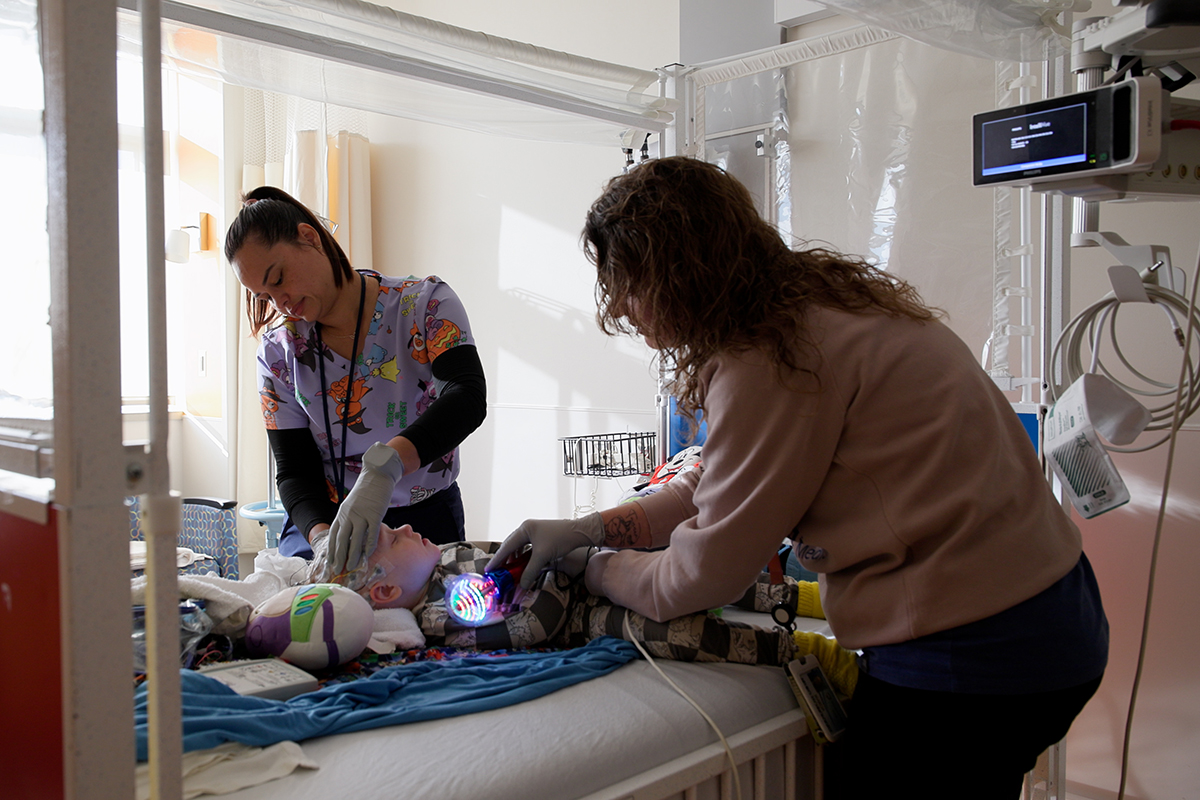
Neurophysiology technologists Kaara Bermudez, left, and Marcia Hawthorne remove Anderson White’s electrodes after a day of monitoring in the Epilepsy Monitoring Unit. Hawthorne uses a light-up spinning toy to help him relax.
Pinpointing Where Seizures Begin
A doctor might recommend a stay in the Epilepsy Monitoring Unit if a child’s seizures aren’t improving with treatment or are severe enough to require emergency care. In some cases, doctors carefully reduce a child’s medication under close supervision to observe their seizures in a safe setting.
The data gathered helps doctors and parents decide which treatments to try next, such as medications, medical devices or surgery.
“If we’re thinking about epilepsy surgery, we need to figure out exactly where the seizures are coming from,” O’Neill said. “Capturing seizures on the EEG helps us do that.”
That insight is especially useful as treatments for childhood epilepsy continue to advance, O’Neill said.
“A lot of patients are good candidates for epilepsy surgery, and the surgeries are less invasive than they were even two decades ago,” O’Neill said.
Some Epilepsy Monitoring Units also use stereo electroencephalography, a minimally invasive procedure in which a surgeon inserts 10 to 20 thin wire electrodes in areas of the brain where seizures are thought to originate.
“This gives us a lot more three-dimensional, precise data on exactly where seizures are coming from,” O’Neill said. “For our toughest seizure cases, that can help us decide whether we can offer surgery to potentially cure the seizures.”
Learn more about Penn State Health’s advanced treatment for epilepsy.
What to Expect During a Stay
Children don’t have to sit still the whole time they’re in the Epilepsy Monitoring Unit. Once EEG leads are attached to their scalp, the child can move around the room and play.
When Anderson stayed in the Epilepsy Monitoring Unit for just over 24 hours, the care team helped make it as enjoyable as possible.
“They brought us a high chair for mealtimes and a mat for him to play on with toys,” Courtney said. “The staff were all very welcoming and helpful throughout our stay.”
Parents can remain with their child and sleep on a pullout couch or chair in each exam room. Their observations can also give doctors a more complete picture of their child’s condition.
“Parents see their kids’ seizures on a day-to-day basis, so having the parents there is very helpful because they can let us know if what we’re seeing is similar to what they see at home,” said Marcia Hawthorne, senior lead neurophysiology technologist in the Epilepsy Monitoring Unit Lab. “Sometimes that can be just as helpful as the EEG.”
Sometimes a doctor adjusts the patient’s medication before they leave the Epilepsy Monitoring Unit. In other cases, patients and parents discuss the results with their neurologist at their next follow-up appointment after leaving the unit. For the White family, the neurologist at the hospital ordered labs and adjusted Anderson’s medication, and they have a follow-up neurology visit scheduled soon.
“Anderson is doing great with the medication changes and has not been experiencing his daily drop seizure events since we made the change,” Courtney said.
Find a Penn State Health epilepsy expert near you.
If you're having trouble accessing this content, or would like it in another format, please email Penn State Health Marketing & Communications.